ESA Letter vs Service Dog: What's the Difference?

ESA Letter vs Service Dog: What's the Difference?
Introduction
If you're considering getting support from an assistance animal, you've probably come across the terms Emotional Support Animal (ESA) and Service Dog. Although these terms are often used interchangeably, they describe two very different types of assistance animals with distinct legal protections, responsibilities, and requirements.
Understanding the difference is important before applying for an ESA letter or considering a Psychiatric Service Dog (PSD). Choosing the right option depends on your individual needs, your daily lifestyle, and the type of support your animal provides.
In this guide, we'll explain the differences between Emotional Support Animals and Service Dogs, discuss their legal protections, housing rights, travel considerations, training requirements, and help you determine which option may be appropriate for your situation.
What Is an Emotional Support Animal (ESA)?
An Emotional Support Animal (ESA) is a companion animal that provides comfort, emotional stability, and therapeutic benefits to an individual experiencing a qualifying mental or emotional health condition.
Unlike Service Dogs, ESAs are not trained to perform specific tasks related to a disability. Their presence alone provides emotional support that may help reduce symptoms associated with conditions such as anxiety, depression, PTSD, or chronic stress.
To request housing accommodations for an ESA, individuals generally need a legitimate ESA letter issued by a licensed healthcare professional following an appropriate clinical evaluation.
Common animals that may serve as ESAs include:
- Dogs
- Cats
- Rabbits
- Birds
- Guinea pigs
- Ferrets
- Other domesticated animals
The most important requirement is not the type of animal but whether it provides emotional support that benefits the individual's mental health.
What Is a Service Dog?
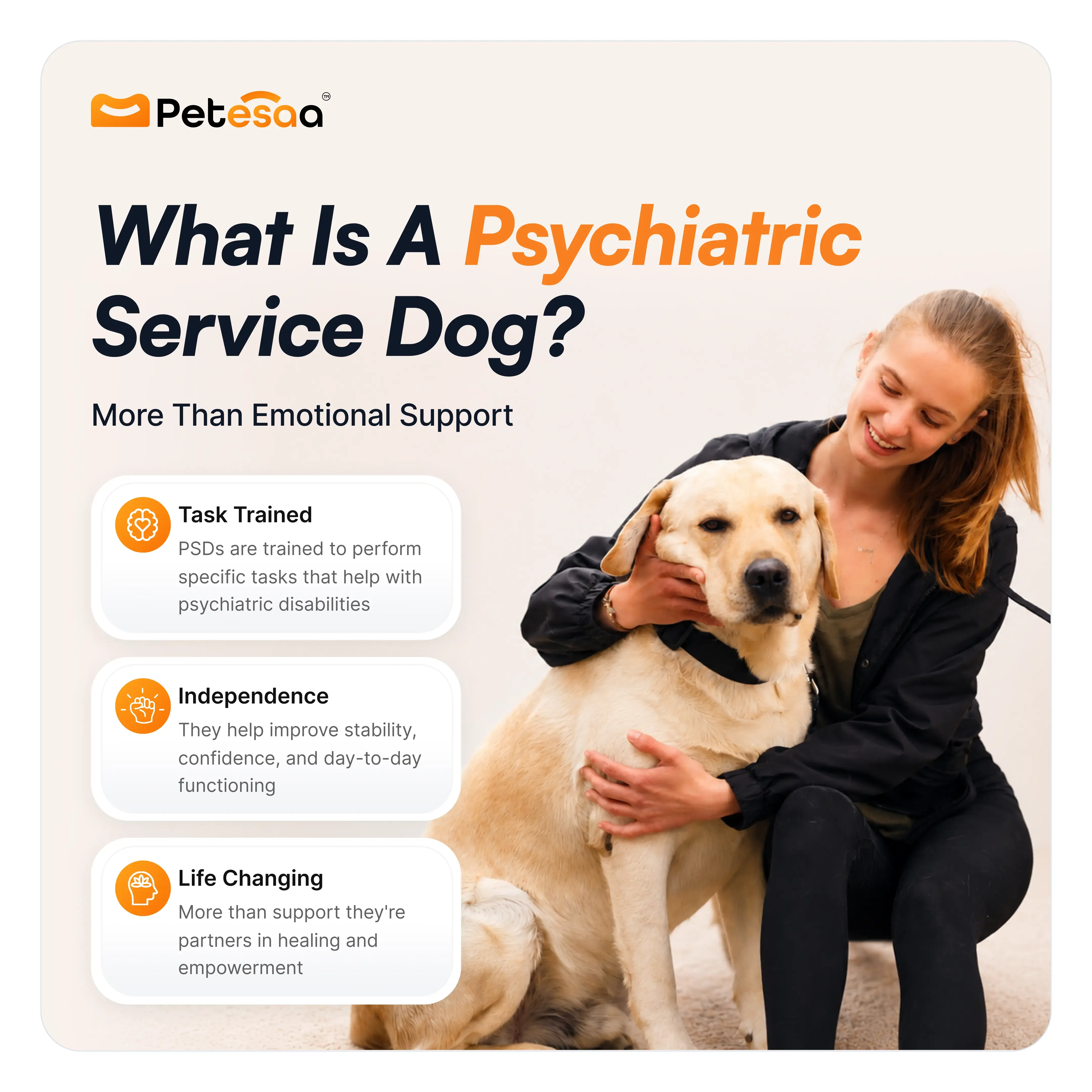
A Service Dog is individually trained to perform specific tasks that directly assist a person living with a disability.
These tasks are tailored to the individual's condition and go beyond providing comfort or companionship.
Examples include:
- Guiding individuals with visual impairments
- Alerting to seizures
- Retrieving medication
- Interrupting panic attacks
- Performing Deep Pressure Therapy (DPT)
- Alerting to changes in medical conditions
- Providing balance or mobility assistance
Unlike ESAs, Service Dogs receive specialized training to reliably perform these tasks in a variety of public settings.
Because of this training, Service Dogs receive broader legal protections under federal law.
Understanding the Legal Differences
One of the biggest distinctions between ESAs and Service Dogs is the legal protection each receives.
Several federal laws address assistance animals, including:
- Fair Housing Act (FHA)
- Americans with Disabilities Act (ADA)
- Air Carrier Access Act (ACAA)
Each law applies differently depending on the type of assistance animal.
Emotional Support Animals
An ESA may qualify for housing accommodations under applicable housing regulations when supported by appropriate documentation from a licensed healthcare professional.
However, ESAs generally do not receive public access rights similar to Service Dogs.
Service Dogs
Service Dogs receive broader legal protections because they are trained to perform disability-related tasks.
Qualified Service Dogs are generally permitted in many public places where pets would not normally be allowed, including:
- Restaurants
- Retail stores
- Hotels
- Airports
- Hospitals (subject to facility policies)
- Public transportation
- Government buildings
This distinction is one of the primary reasons many people confuse ESAs and Service Dogs.
Training Requirements
Training is perhaps the largest difference between these two assistance animals.
Emotional Support Animals
An ESA does not require specialized task training.
The animal simply needs to provide emotional comfort through companionship.
Basic obedience is recommended to ensure the animal behaves appropriately in residential environments.
Service Dogs
Service Dogs require significant training before they can reliably assist their handler.
Training may include:
- Public behavior
- Task performance
- Obedience
- Socialization
- Emergency response
- Environmental exposure
Many Service Dogs spend months or even years completing professional training programs before working full time.
Which One Is Right for You?
Choosing between an ESA and a Service Dog depends on the support you need.
An Emotional Support Animal may be the right choice if:
- Your primary need is emotional comfort.
- Your symptoms are mostly managed at home.
- You want to request housing accommodations.
- Your pet already provides meaningful emotional support.
A Service Dog may be more appropriate if:
- You require assistance with specific disability-related tasks.
- You need support in public settings.
- Your condition significantly affects daily functioning.
- You're prepared for the responsibilities of ongoing task training.
Understanding these differences can help you make an informed decision while ensuring you pursue the option that best fits your individual circumstances.
Housing Rights for ESAs and Service Dogs
One of the main reasons people seek an Emotional Support Animal (ESA) letter or rely on a Service Dog is to receive housing accommodations. While both types of assistance animals may be protected in qualifying housing situations, the rights and documentation requirements differ.
Individuals with a legitimate ESA letter issued by a licensed healthcare professional may request reasonable accommodations from housing providers when they have a qualifying mental or emotional health condition. This can allow them to live with their emotional support animal even in properties that have pet restrictions, subject to applicable laws and specific housing circumstances.
Service Dogs also receive housing protections and are generally accommodated because they assist individuals with disabilities by performing specific trained tasks.
It's important to remember that housing providers evaluate every request individually. Providing accurate documentation and responding promptly to any verification requests can help make the accommodation process smoother.
Public Access Rights
Public access is one of the biggest differences between Emotional Support Animals and Service Dogs.
Emotional Support Animals
An Emotional Support Animal provides comfort through companionship but is not granted general public access rights simply because it is an ESA. Restaurants, grocery stores, shopping malls, hotels, and other businesses that prohibit pets are generally not required to admit ESAs.
Individual businesses may choose to welcome pets, but this decision is separate from assistance animal laws.
Service Dogs
Service Dogs are individually trained to perform tasks directly related to a person's disability. Because of their specialized training, they are generally allowed to accompany their handlers into most public places where pets are normally prohibited.
Examples include:
- Restaurants
- Retail stores
- Hotels
- Public transportation
- Airports
- Government buildings
- Medical facilities (subject to safety requirements)
Handlers are expected to keep their Service Dog under control at all times. A dog that behaves aggressively or causes significant disruption may be asked to leave regardless of its status.
Air Travel Considerations
Travel rules have changed over the years, making it important to understand the distinction between ESAs and Service Dogs before flying.
Traveling with an ESA
Many airlines no longer recognize Emotional Support Animals as Service Animals. In most cases, ESAs travel according to the airline's standard pet policy, which may include carrier requirements, size restrictions, and additional fees.
Before booking your flight, always review your airline's current pet and assistance animal policies.
Traveling with a Service Dog
Qualified Service Dogs are generally permitted to accompany their handlers on flights, provided the airline's documentation and behavioral requirements are met.
Planning ahead and checking airline-specific requirements can help avoid unexpected delays during travel.
Do You Need an ESA Letter?
If your animal primarily provides emotional comfort rather than performing trained disability-related tasks, you may benefit from obtaining a legitimate ESA letter.
A valid ESA letter should always come from a licensed healthcare professional after an independent clinical evaluation. It is not the same as purchasing an online registration, ID card, or certificate.
A legitimate ESA letter generally includes:
- Provider's name
- Professional license information
- Date of issuance
- Professional recommendation
- Signature
- Contact information for verification
Choosing a reputable telehealth platform helps ensure your documentation meets applicable housing requirements.
Common Myths About ESAs and Service Dogs
Because assistance animal laws are often misunderstood, many misconceptions continue to circulate online. Let's separate fact from fiction.
Myth 1: ESAs Can Go Anywhere
Fact: Emotional Support Animals do not automatically receive public access rights. Their protections primarily relate to qualifying housing accommodations.
Myth 2: Every Dog Is a Service Dog
Fact: Simply providing comfort does not make a dog a Service Dog. A Service Dog must be individually trained to perform specific disability-related tasks.
Myth 3: ESA Registration Is Required
Fact: There is no official federal ESA registry. A legitimate ESA letter not a registration certificate is what matters for housing accommodation requests.
Myth 4: Any Website Can Sell a Valid ESA Letter
Fact: Legitimate ESA documentation should only be issued after an evaluation by a licensed healthcare professional. Be cautious of websites promising instant approval without any clinical assessment.
Frequently Asked Questions
Can any dog become an Emotional Support Animal?
Many domesticated animals, including dogs and cats, may serve as Emotional Support Animals if they provide meaningful emotional support and a licensed healthcare professional determines that an ESA is clinically appropriate.
Can my landlord verify my ESA letter?
Yes. Housing providers may verify that the letter was issued by a licensed healthcare professional while respecting your medical privacy.
Do Service Dogs need certification?
There is no universal federal certification required for Service Dogs. What matters is that the dog is individually trained to perform disability-related tasks and behaves appropriately in public.
Does an ESA require special training?
No. Emotional Support Animals are valued for the comfort and companionship they provide rather than specialized task training. Basic obedience is still recommended for responsible ownership.
Can I have more than one Emotional Support Animal?
Depending on your circumstances, a licensed healthcare professional may determine that more than one Emotional Support Animal is appropriate. Housing providers evaluate these requests individually.
Why Choose Petesaa?
Obtaining assistance animal documentation should be straightforward, secure, and handled by qualified professionals.
Petesaa simplifies the process by connecting individuals with licensed healthcare professionals through a secure online platform.
When clinically appropriate, you'll receive documentation that is designed to support housing accommodation requests and includes provider information for verification.
Why thousands trust Petesaa:
- Licensed healthcare professional evaluations
- Secure online assessment process
- Fast digital delivery after approval
- Transparent pricing
- Privacy-focused platform
- Professional verification support
- Responsive customer assistance
Every evaluation is completed independently, and approval depends entirely on the provider's professional clinical judgment.
Final Thoughts
Although Emotional Support Animals and Service Dogs both improve the lives of individuals with disabilities and mental health conditions, they serve different purposes and are protected under different laws.
An Emotional Support Animal offers comfort and companionship, making it an excellent option for individuals who benefit from emotional support at home and need housing accommodations.
A Service Dog, on the other hand, is individually trained to perform specific tasks that assist a person with a disability, allowing greater independence and broader public access rights.
Understanding these distinctions helps you make informed decisions, avoid misinformation, and pursue the option that best aligns with your needs.
If you're considering an Emotional Support Animal, working with a trusted telehealth platform like Petesaa can help you navigate the evaluation process with confidence.
Ready to Begin Your ESA Journey?
If you believe an Emotional Support Animal could benefit your mental well-being, Petesaa makes it easy to take the next step.
Complete a secure online assessment, connect with a licensed healthcare professional in your state, and if approved receive your ESA letter electronically, often within a short timeframe.
Start your evaluation today and discover whether an Emotional Support Animal is the right choice for you.

Can You Have More Than One Emotional Support Animal? Here's What to Know

Can You Get an ESA Letter for Anxiety? Everything You Need to Know

Can My Family Member Use My ESA Letter? Understanding Who an ESA Letter Covers

Can I Get an ESA Letter Before Moving? A Complete Moving Guide for Renters

Can an Emotional Support Animal Live in a No-Pets Apartment? What You Should Know

ESA Letter Renewal: When Should You Renew Your Emotional Support Animal Documentation?

5 Signs an Emotional Support Animal May Be Right for You

Top 10 Reasons Your ESA Letter Could Get Rejected by Your Landlord (And How to Avoid Them)

What Animals Can Be Emotional Support Animals? A Complete Guide for Pet Owners

Are Online ESA Letters Legitimate? Here's How to Avoid Scams

Can You Have More Than One Emotional Support Animal? Everything You Need to Know
Can a Landlord Deny an ESA Letter? Know Your Housing Rights

Do You Need to Renew Your ESA Letter Every Year? Everything You Should Know